Get the latest news and most up-to-date facts about dairy farming.
Lady Shamrock's diary
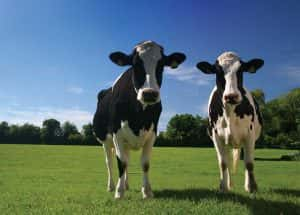
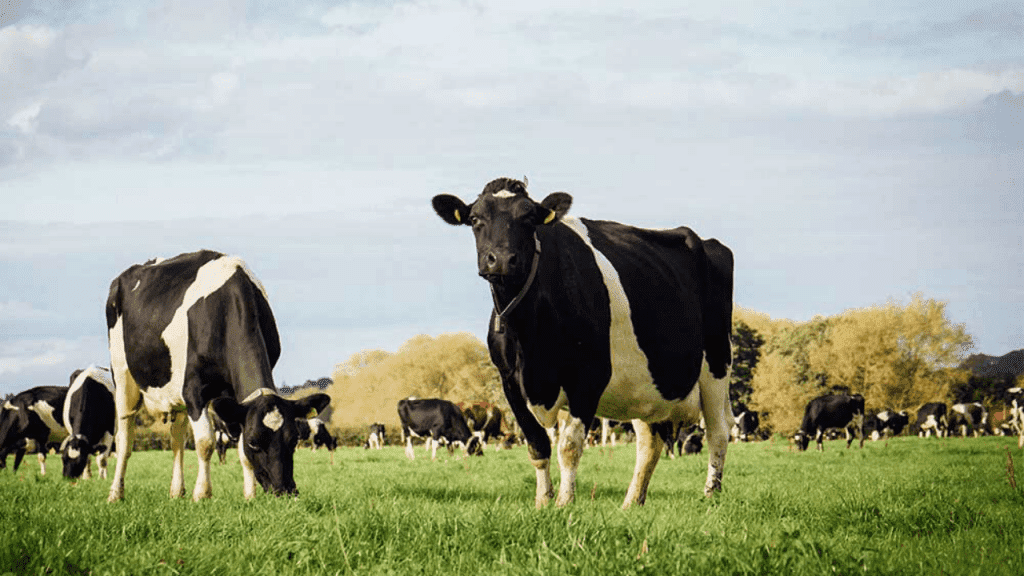
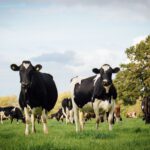
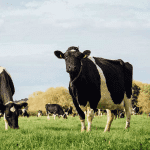
Thanks for stopping by. My name is Lady Shamrock and I'm a dairy cow - one of around 1.5 million in Britain. I'm a Friesian which means I have a black coat. Friesians are pretty common, but Holstein-Friesians are the most common in Britain.
I've met other types, of course, although they are not as common: Jersey cows (small and beige in colour), Guernseys (brown and white) and Ayrshires (orange to a dark brown).
We're social animals and I have to say we get along pretty well in the herd, although there's usually one who always has to get to the milking parlour first! Bit annoying, but I have plenty of other friends. Apparently the experts have found out that we recognise up to 60 other cows in the herd.
Some people wonder what a typical British dairy farm is like, but there really isn't such a thing. There are around 12,500 farms in Britain so naturally they come in all kinds of shapes and sizes, with farmers using lots of different systems.
That said, I'm like the majority of cows - I graze outdoors during the summer and stay indoors during the winter. Typically I eat grass throughout the year - the fresh kind in the summer when I'm out grazing and the stored variety (silage) in winter. Silage is grass that has been stored to preserve all the goodness for those days when it's too cold for grass to grow. It's good stuff.
I need a balanced diet, so sometimes a guy with a clipboard will turn up and talk to farmer Jane farmer about things like the ratio of cereals and silage. They come up with a plan for what I need to eat to stay healthy. Can't help feeling a bit like Madonna on those days. The diet is pretty complex but I know it's good to include grass or maize and cereals - and we get special cubes to lick that give us the minerals and vitamins we need.
Apparently some clever scientists have worked out that cows like routines (I could have told them that!) so most days are the same. I start early in the milking parlour. Chances are I'll be going into a herringbone parlour, but on some farms cows will stand on a slowly rotating platform or even milk themselves using robots!
After milking I spend some time with my mates in the barn or outside. I'm a ruminant (fancy word for someone who re-chews food before digesting it) so chances are I'll be tucking into some of that tasty food the nutritionist and farmer put together for me. On some farms there are big brushes for our backs to rub against, so that's also a popular pastime - there's nothing like a good back scratch!
In the afternoon it's time for milking again. And at the end of that we'll have produced around 2,000 litres of milk. Pretty impressive, if I do say so myself!
On some days we have visitors. The vet, foot trimmer or nutritionist might stop by to check that we're all ok and have everything we need. Or we'll meet someone like you, who is interested in finding out a bit more about us. Hope you come again soon.
For more information about dairy farming in Britain, watch the 'moovies' filmed on farms across the country, or take a virtual tour of a dairy farm.
All about dairy farming
We drink around 5 billion litres of milk in Britain each year - the equivalent of 2,000 Olympic-size swimming pools or enough to drink a glass of milk every day for 54 million years.
Caring for the environment
Dairy farms have traditionally played an important role in rural
Britain, with farmers taking great care and pride in protecting the
environment.
Read more about this